Learning the huge bang with synthetic intelligence

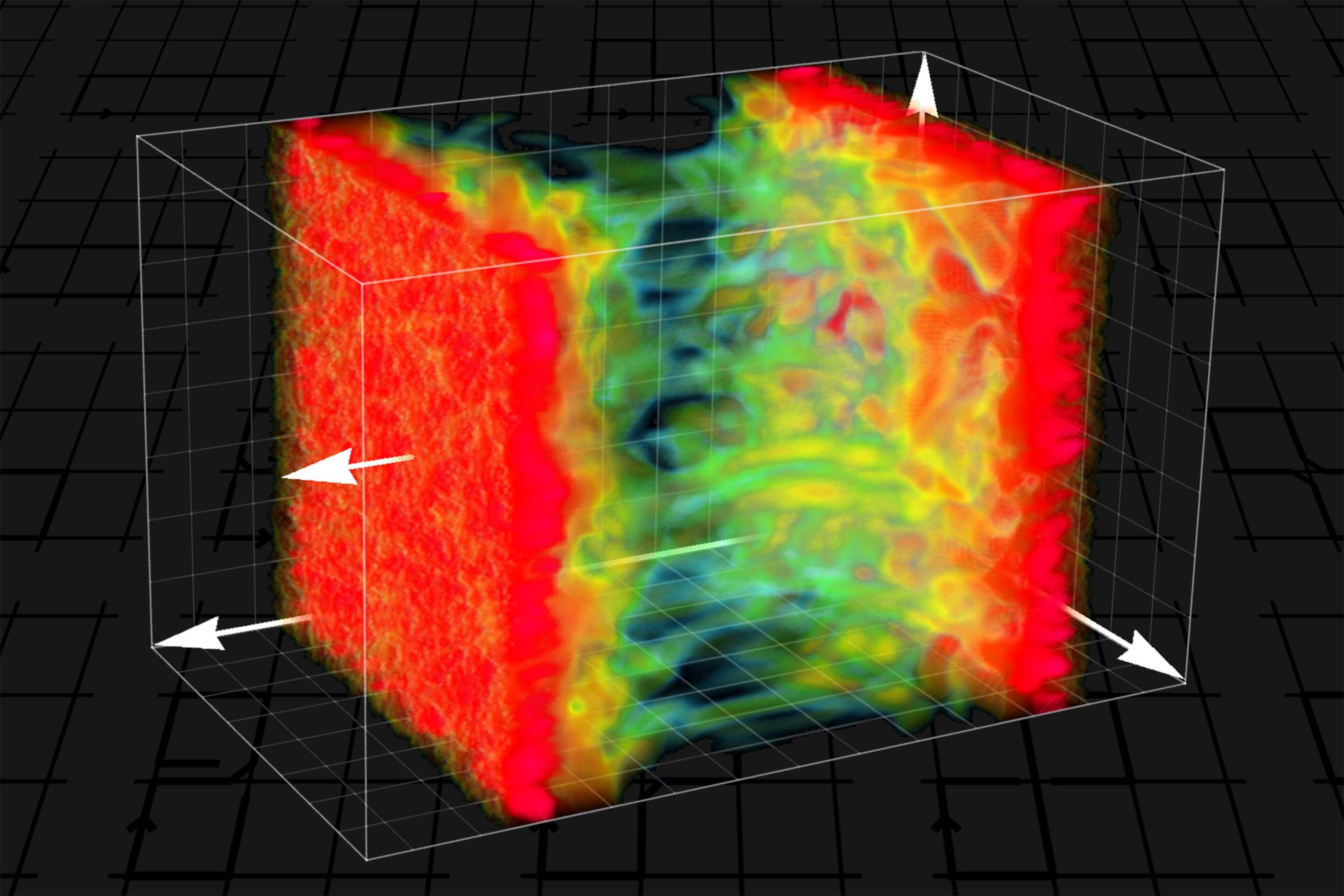

It could rarely be far more complex: small particles whir all around wildly with really substantial electricity, a great number of interactions arise in the tangled mess of quantum particles, and this effects in a point out of matter recognized as “quark-gluon plasma”. Immediately following the Huge Bang, the overall universe was in this point out right now it is manufactured by large-electricity atomic nucleus collisions, for instance at CERN.
This sort of processes can only be analyzed working with higher-efficiency pcs and extremely advanced pc simulations whose success are complicated to evaluate. For that reason, making use of artificial intelligence or device mastering for this reason seems like an clear plan. Common device-mastering algorithms, having said that, are not ideal for this task. The mathematical homes of particle physics require a extremely unique framework of neural networks. At TU Wien (Vienna), it has now been proven how neural networks can be successfully made use of for these tough jobs in particle physics.
Neural networks
“Simulating a quark-gluon plasma as realistically as probable necessitates an really huge total of computing time,” says Dr. Andreas Ipp from the Institute for Theoretical Physics at TU Wien. “Even the major supercomputers in the globe are confused by this.” It would for that reason be desirable not to calculate each individual element precisely, but to understand and predict selected houses of the plasma with the support of artificial intelligence.
Hence, neural networks are applied, related to those people employed for image recognition: Synthetic “neurons” are connected alongside one another on the laptop in a related way to neurons in the brain—and this produces a network that can realize, for illustration, no matter if or not a cat is visible in a selected picture.
When implementing this approach to the quark-gluon plasma, nonetheless, there is a significant challenge: the quantum fields employed to mathematically describe the particles and the forces involving them can be represented in different various methods. “This is referred to as gauge symmetries,” states Ipp. “The standard basic principle at the rear of this is anything we are acquainted with: if I calibrate a measuring machine otherwise, for example if I use the Kelvin scale alternatively of the Celsius scale for my thermometer, I get entirely various figures, even though I am describing the identical bodily state. It really is equivalent with quantum theories—except that there the permitted variations are mathematically much additional intricate.” Mathematical objects that appear totally various at 1st look could in reality explain the very same physical condition.
Gauge symmetries built into the construction of the community
“If you really don’t acquire these gauge symmetries into account, you are not able to meaningfully interpret the success of the pc simulations,” suggests Dr. David I. Müller. “Instructing a neural network to figure out these gauge symmetries on its very own would be particularly tough. It is much far better to start off out by developing the construction of the neural network in this sort of a way that the gauge symmetry is instantly taken into account—so that distinctive representations of the exact actual physical point out also create the same signals in the neural community,” says Müller. “That is just what we have now succeeded in doing: We have designed fully new network layers that automatically choose gauge invariance into account.” In some check apps, it was proven that these networks can essentially find out substantially greater how to offer with the simulation knowledge of the quark-gluon plasma.
“With this sort of neural networks, it becomes feasible to make predictions about the system—for case in point, to estimate what the quark-gluon plasma will seem like at a afterwards stage in time with out definitely having to work out each individual single intermediate step in time in element,” states Andreas Ipp. “And at the similar time, it is ensured that the process only creates results that do not contradict gauge symmetry—in other words, outcomes which make perception at the very least in theory.”
It will be some time before it is possible to entirely simulate atomic core collisions at CERN with these solutions, but the new form of neural networks presents a totally new and promising resource for describing bodily phenomena for which all other computational strategies may well never be potent more than enough.
The exploration was revealed in Physical Review Letters.
Very first detection of unique ‘X’ particles in quark-gluon plasma
Matteo Favoni et al, Lattice Gauge Equivariant Convolutional Neural Networks, Physical Evaluation Letters (2022). DOI: 10.1103/PhysRevLett.128.032003
Quotation:
Learning the big bang with artificial intelligence (2022, January 25)
retrieved 30 January 2022
from https://phys.org/information/2022-01-massive-artificial-intelligence.html
This doc is issue to copyright. Apart from any fair dealing for the reason of private review or exploration, no
part may be reproduced with out the published permission. The content is offered for facts purposes only.