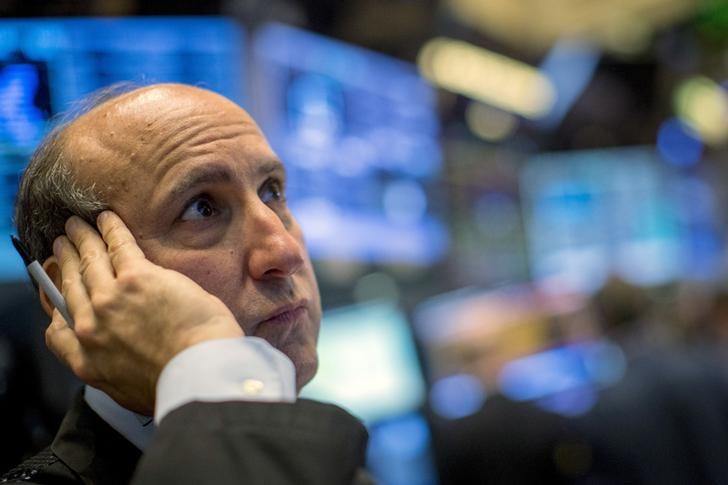
Analysis: Marketplaces will have to deal with up to tightening economical circumstances

/cloudfront-us-east-2.images.arcpublishing.com/reuters/VZ4DP6AVZJLJRDKO2FVNXMEDZA.jpg "Analysis: Marketplaces will have to deal with up to tightening economical circumstances")
Table of Contents
May well 9 (Reuters) – Already sitting down on double-digit losses this calendar year, inventory current market buyers should brace for additional, as the realisation sinks in that the U.S. Federal Reserve intends to tighten financial disorders to get on major of purple-sizzling inflation.
Fundamentally, money disorders evaluate how very easily homes and companies can entry credit rating, so are important in displaying how monetary policy transmits to the economy. Fed manager Jerome Powell repeated on Wednesday he will be maintaining a near eye on them.
And they have a bearing on long run advancement – Goldman Sachs estimates a 100 foundation-point tightening in its proprietary financial conditions index (FCI) – which variables in premiums, credit rating and equity levels as well as the dollar – crimps progress by a person proportion position above the subsequent 12 months.
Sign up now for Absolutely free unlimited access to Reuters.com
Goldman’s and other indexes from the Chicago Fed and IMF all show financial situations have tightened appreciably this yr but keep on being free historically, a testomony to the scale of stimulus unleashed to assistance economies temperature the pandemic.
Sven Jari Stehn, main European economist at Goldman Sachs, estimates the bank’s U.S. monetary circumstances index will need to have to tighten relatively additional for the Fed to achieve a “delicate landing”, i.e. to slow progress but not excessively.
Goldman’s U.S. FCI is at 99 factors – 200 bps tighter than at the commence of the 12 months and the tightest given that July 2020. Situations tightened .3 factors on Thursday, as shares tanked, the dollar hit two-10 years highs and 10-12 months bond yields shut over 3%.
But they even now keep on being traditionally loose.
“Our estimate is that the Fed fundamentally needs to halve (the work-personnel gap) to attempt to get wage progress back again to a extra usual advancement amount,” Stehn explained.
“To do that they effectively need to have to decrease progress to a amount of all around 1% for a 12 months or two, so you have to go down below trend for a calendar year or two.”
He expects 50 bps hikes in June and July, then 25 bps moves until finally coverage charges rise just previously mentioned 3%. But if circumstances do not tighten adequate and wage progress and inflation do not moderate sufficiently, the Fed may go on with 50 bps hikes, he mentioned.
FCI looseness appears puzzling given current market bets that the Fed will lift charges over 3% by year-close whilst jogging down its bond holdings, sharply better Treasury yields and tumbling shares.
But the S&P 500 however trades 20% earlier mentioned its pre-pandemic peak. Through the wealth influence, equity price ranges are thought to guidance family paying out.
That may well modify – the Fed stopped escalating its equilibrium sheet in March and will start slicing it from June, ultimately at a regular monthly $95 billion price, embarking on quantitative tightening (QT)
Michael Howell, running director at consultancy Crossborder Capital, famous that U.S. equity declines have tracked a 14% fall in productive liquidity provision by the Fed since December.
He estimates, centered on pandemic-time inventory rallies and current falls, each individual regular monthly reduction could knock 60 details off the S&P 500.
The inventory current market “is definitely not discounting any further more reduction in liquidity, and we know that’s going to materialize,” Howell reported.
UNFAMILIAR TERRITORY
The problem is whether the Fed can tighten conditions just plenty of to amazing rates but not so much that progress and markets are seriously hit.
A threat – highlighted by Bank of England policymaker Catherine Mann – is that central banks’ substantial stability sheets may well have muted transmission of monetary policy into fiscal situations.
If so, the Fed may perhaps need to have to act a lot more aggressively than predicted.
Mike Kelly, head of world multi-asset at PineBridge Investments, mentioned that previous QT episodes experienced been significantly lesser so “we are going into an environment that no one’s ever noticed in advance of.”
In the course of the QT routines of 2013 and 2018, stocks tanked 10%, forcing the Fed to simplicity back on tightening. read through far more
But these made use of to relying on the Fed “place” – the perception it will action in and backstop stock markets – must look at out Citi analysts reckon this set could not kick in just before the S&P 500 endures another 20% fall.
“In which you have 8.5% inflation… the strike value of the central lender put selection is a great deal decreased than it made use of to be,” claimed Patrick Saner, head of macro method at insurance provider Swiss Re.
Sign up now for Free of charge limitless access to Reuters.com
Reporting by Yoruk Bahceli modifying by Sujata Rao Editing by Louise Heavens
Our Specifications: The Thomson Reuters Rely on Ideas.