A simple calculation can quit artificial intelligence sending you broke


Table of Contents
Mike is a 40-something crop farmer from southern Queensland. With a chestnut tan, crushing handshake and a sturdy outback accent, he’s the third generation of his family members to grow sorghum, a cereal mainly utilized for animal fodder.
But, like most farmers, Mike faces extra worries than his forbears. Local climate modify has eroded Australian farms’ profitability by an normal of 23% in excess of the earlier 20 yrs. It is a continual problem to improve productivity by producing much more with significantly less.
Read more:
Australian farmers are adapting nicely to local weather improve, but you can find perform ahead
Right after the devastating 2019 bushfire period, Mike commenced exploring “smart” farming approaches enabled by synthetic intelligence (AI). Agriculture has been known as 1 of the most fertile industries for AI and machine understanding. Mike was enthused about an AI run procedure enabling him to use significantly less fertiliser and water.
Immediately after months of inquiries he observed a organization promising its know-how could cut down crop inputs by up to 80%. It involved software processing data from electronic sensors placed across his fields to let “precision farming” – tailoring drinking water, pest and fertiliser therapy for each individual plant.
The salesperson’s pitch was compelling. But the cost to install the process was $500,000, in addition $80,000 a year for facts storage and processing. Assistance costs have been on leading of that.
In the end, Mike calculated the price tag would offset any more profit created, even if the slick technological innovation lived up to all the guarantees. If it delivered much less, it would only assist him into personal bankruptcy.
This expertise – of staying pitched an AI technologies with massive claims but questionable worth – is popular. It’s uncomplicated to be swayed by the promises. But new technological know-how is not the answer to every little thing. For it to be truly worth the money for men and women like Mike – in truth any organisation – requires a cold calculation of its financial worth.
In this write-up we present a basic methodology to do so.
Blinded by technological probable
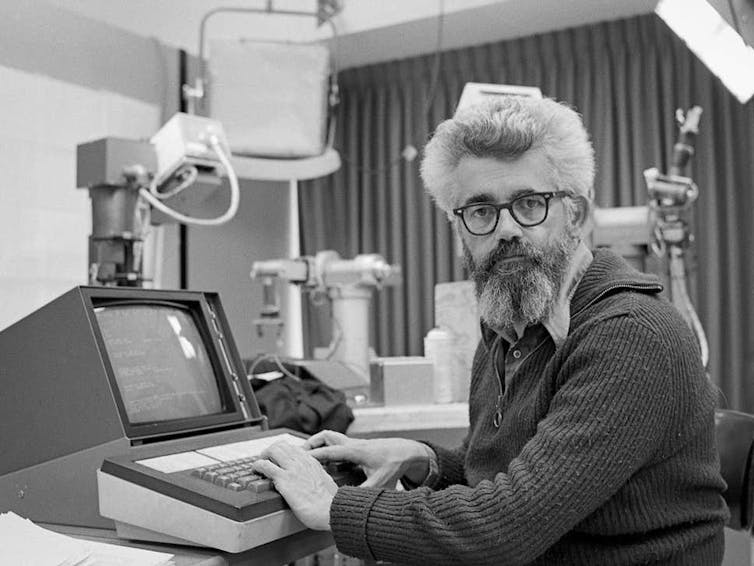
For all the concentrate now on how AI will revolutionise the world, hoopla about it is not new. Given that the inception of simple AI strategies in the early 1960s, obsession with AI potential has led to two key “AI winters” – in which huge investments by organizations and analysis institutions unsuccessful to provide promised benefits.
The very first was in the 1970s, when revenue poured into range of AI programs these kinds of as speech recognition and device translation. The next was in the 1980s, when corporations invested intensely in so-termed “qualified devices” meant to do points like diagnose health problems or control place shuttle launches.
AP
In both of those circumstances what the technological innovation could do fell perfectly small of the hype. It was not that AI was useless. Far from it. But what it could do had limited economic price.
The backlash set the scientific and economic progress of the know-how back again pretty much a ten years the two times, as funding and curiosity dissipated.
To be guaranteed your expenditure in technological know-how is worthy of the income, you have to have to guard towards being swept up by the claims and possibilities.
As Ben Robinson, then main strategy officer at economic software program organization Temenos, set it in 2018:
we can safely and securely predict it will not be blockchain or APIs or AI that transform the field. Instead it will be new company types empowered by individuals technologies.
Go through additional:
If devices can be inventors, could AI shortly monopolise technological innovation?
Aim on the economics
The adhering to figures define a uncomplicated approach to concentrate on the economics, not the engineering.
Determine 1 summarises the standard economics of any expenditure choice. Invest if the additional earnings is bigger than the “opportunity cost” – the benefit you can attain from paying out your cash an additional way, or by not expending the cash.
Figure 1 can be tricky to use so Figure 2 frames the expenditure choice in a little far more specific conditions employing the economic notion of “marginal utility” – the added (marginal) advantage (utility) that arrives from added expenditure.
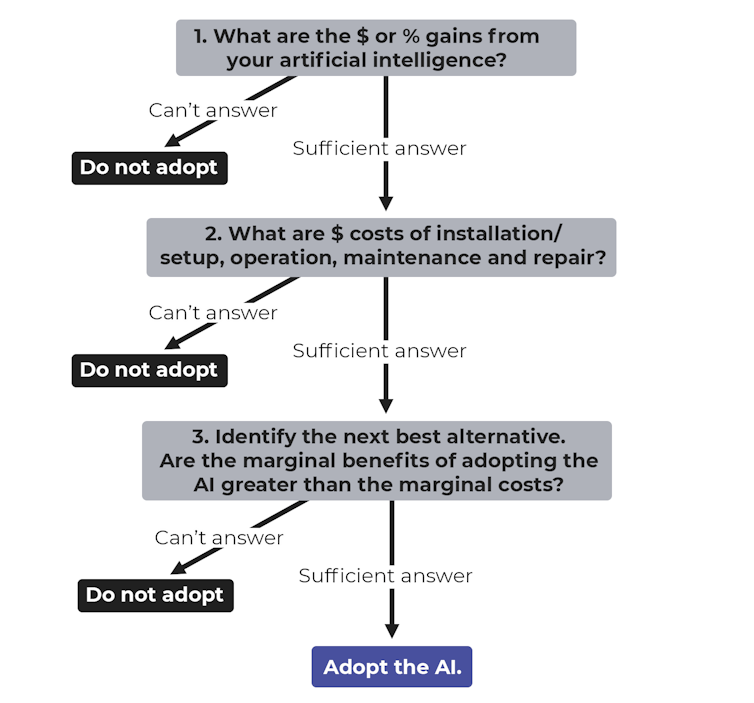
To make this simple to implement, Figure 3 summarises this decision-earning procedure into a simple “decision tree”.
The Conversation/Writer provided, CC BY-ND
Resolving Mike’s AI financial investment challenge
Implementing this methodology to Mike’s problem, we can see why he couldn’t make enterprise feeling of the pitch of AI-enabled precision farming.
The salesperson handed the first issue by stating the gains from AI adoption would lessen Mike’s crop enter expenditures by up to 80%. This would translate to Mike preserving about $80,000 per yr (in the most effective-circumstance scenario).
The salesperson also handed the next concern, with a distinct statement of the system’s price.
But the business enterprise scenario unsuccessful on the 3rd issue. The ideal-scenario marginal profit of adopting the AI (preserving $80,000 a year) was just equal to the marginal expense ($80,000 a year) – not counting the first installation.
Examine far more:
Artificial intelligence is now portion of our each day life – and its increasing ability is a double-edged sword
Placing it this way helps make it evidently appear like a dud financial commitment, and that Mike did not have set a lot of time into deciding from it. But the fact is many selections to spend in AI do not make economic feeling and the over course of action will make this straightforward to know why.
Employing an financial framework of worthy of, somewhat than an engineering assert of possibility, is the initial action to make better selections. Executing so decreases the prospect of one more AI winter season, and improves the probability of true gains contributing to a additional affluent and sustainable world.