Ukrainian YouTuber Finds Her AI Clone Marketing Russian Goods on Chinese World-wide-web
 Marcia Clark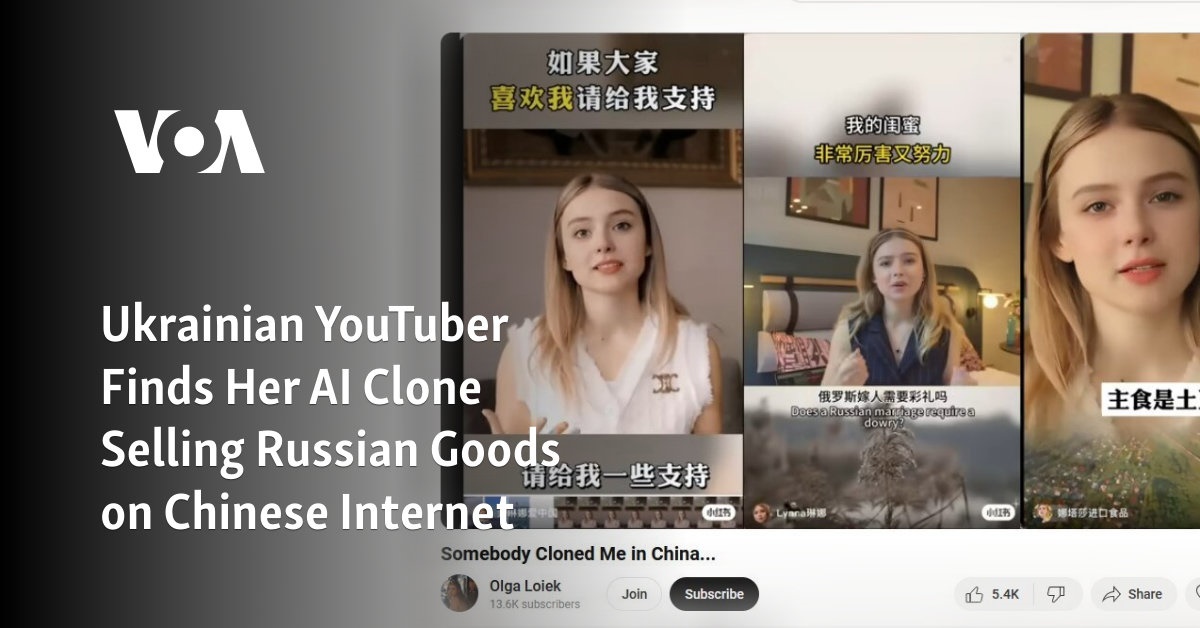
Talking Mandarin and promoting like for China, a great number of video clips of overseas-hunting women created with artificial intelligence began popping up on Chinese social media platforms all over the Lunar New Yr before this month.
The avatars in the video clips are produced with on the internet illustrations or photos that are stolen, reproduced and repurposed so that even the ladies in actual daily life recognize them selves in the videos.
Olga Loiek is one particular of those women. She’s a 20-year-old Ukrainian who experiments cognitive science at the College of Pennsylvania. A few of months ago, Loiek begun a YouTube channel where she talks about psychological health and fitness and shares her philosophies about life.
Nevertheless, soon just after that, she commenced acquiring messages from followers telling her that they experienced viewed her on Chinese social media. There, she’s not Olga Loiek but a Russian female who speaks Mandarin, enjoys China and desires to marry a Chinese gentleman. Her name is Natasha, or Anna, or Grace, dependent on the social media system you obtain her on in China.
“I begun translating the movies with Google Translate, and I understood that most of these accounts are talking about items like China, Russia, how good the relationship amongst China and Russia is,” she informed VOA. “This feels incredibly violating.”
In some movies, the avatars speak about how considerably they value Russia and China’s shut ties. In other films, they praise Chinese background and culture or speak about how a great deal Russian ladies want to marry Chinese.
“If you marry Russian women, we will clean dresses, prepare dinner, and clean dishes for you each and every day,” an avatar said. “We will also give you foreign toddlers, as a lot of as you want.”
Numerous dozen video clips of Loiek’s avatar speaking Mandarin have been found on video clip web pages Douyin and Bilibili. Most of these accounts would inquire viewers to pay a visit to their on-line merchants to invest in what they say are authentic Russian products.
Douyin, China’s variation of TikTok, has labeled some of these videos as perhaps AI-generated. But remarks exhibit that quite a few believed they had been hunting at a serious female. One netizen wrote, “Russian attractiveness, Chinese individuals welcome you.”
Loiek reported she would never say points like that, obviously, offered that she’s from Ukraine, which has been at war with Russia due to the fact 2022.
She said, “This is likely utilised to make people, perhaps men and women in China, truly feel that foreigners experience that their region is outstanding.”
On Bilibili, China’s most important movie web site, some AI movies using Loiek’s encounter are marked with the emblem of HeyGen, indicating that the online video was produced on the firm’s web site.
In one tutorial on Bilibili, the demonstrator even demonstrates how to make a shorter video on HeyGen with a clip of Loiek talking.
HeyGen is an AI corporation headquartered in Los Angeles that was introduced in China in 2020. It specializes in sensible electronic avatars, voice technology and online video translating.
The technological know-how formulated by HeyGen was made use of in AI videos of Donald Trump and Taylor Swift speaking best Mandarin that went viral on Chinese social media in October 2023. According to Forbes, the business is now valued at $75 million.
HeyGen’s moderation plan states that buyers are not able to generate avatars that “signify authentic people today, like stars or general public figures, devoid of specific consent.” The company’s formal tutorial online video on avatar producing reveals that consumers ought to post a video of folks providing consent to the use of their likeness. It truly is unclear how some in China could circumvent the prerequisite to make video clips of Loiek.
Loiek mentioned that considering the fact that she and her YouTube subscribers have despatched grievances to Chinese social media corporations, about a dozen of the accounts imitating her have been taken down.
VOA achieved out to HeyGen and Douyin’s mother or father business, ByteDance, for feedback but has not obtained a response.
The Chinese govt rolled out provisions to control deepfakes and other “deep synthesis expert services” in early 2023. The legislation prohibits building deepfakes devoid of the consent of the folks whose image or other details is employed.
Loiek posted her tale on YouTube, and it has been shared on Chinese social media. Netizens across platforms sympathized with her and identified as for tougher restrictions on AI.
Chinese tech giants this sort of as Baidu and Tencent are investing closely in AI technology. One particular of the most hyped-up products and services driven by AI is electronic people.
Tencent and Xiaoice, a Chinese AI studio spun off from Microsoft, offer electronic human products and services that can clone individuals and flip them into AI avatars for as little as $145.
AI avatars have also been uncovered in on the net disinformation campaigns that distribute professional-China and anti-U.S. narratives. In February 2023, exploration company Graphika identified a social media marketing campaign promoting Beijing’s pursuits using realistic-wanting computer-produced persons in films.
In September 2023, the U.S. Condition Section warned in a report, “Obtain to global knowledge blended with the most up-to-date developments in artificial intelligence technological know-how would permit the PRC [People’s Republic of China] to surgically concentrate on foreign audiences and therefore perhaps impact financial and safety conclusions in its favor.
As for Loiek, she does not prepare to give up YouTube or quit posting.
“We need to have some form of regulatory frameworks, so we can realize and we can stop these things from occurring,” she reported.
Adrianna Zhang contributed to this report.